

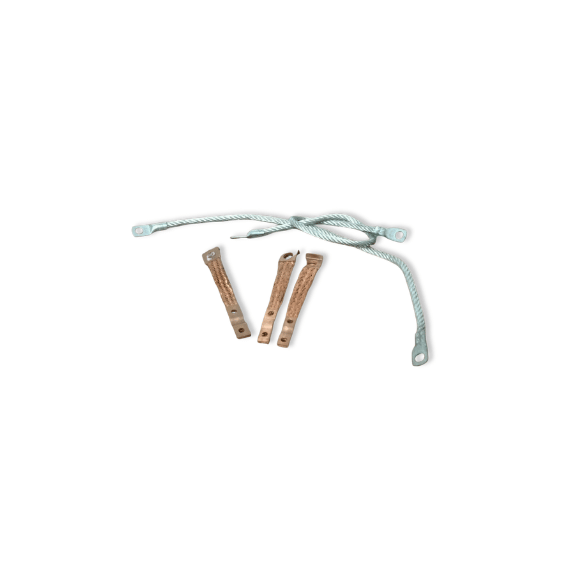
Description
Braided Links are flexible electrical connectors used for grounding, bonding and high-current transmission in wind turbine and renewable energy systems. Their braided construction absorbs vibration, movement and thermal expansion while maintaining reliable electrical continuity. They are commonly manufactured from high-conductivity copper with optional tin or nickel plating for improved corrosion resistance. Custom lengths, widths, terminal configurations and hole patterns are available. These links are suitable for nacelles, generators, converters, switchgear and electrical cabinets.
Product Specifications
| Product Name | Braided Links |
|---|---|
| Conductor Material | High-Conductivity Copper |
| Material Grade | Electrolytic Copper or as per customer requirement |
| Plating Options | Bare Copper, Tin-Plated Copper or Nickel-Plated Copper |
| Braid Type | Flat Braided, Round Braided or Multi-Layer Braided Link |
| Cross-Sectional Area | Customised according to current-carrying requirements |
| Width | Available in standard or customised widths |
| Thickness | Customised according to braid construction and application |
| Length | Standard or customised length as per drawing |
| Terminal Material | Copper, Tinned Copper or Application-Specific Metal |
| Terminal Type | Pressed Lug, Ferrule, Palm, Plate or Custom Terminal |
| Hole Configuration | Single Hole, Double Hole, Slotted Hole or Custom Pattern |
| Manufacturing Process | Braiding, Cutting, Pressing, Crimping, Welding and Drilling |
| Electrical Conductivity | High electrical conductivity with low contact resistance |
| Current Capacity | Determined by conductor size, braid construction and operating conditions |
| Flexibility | High flexibility for vibration and movement absorption |
| Operating Environment | Indoor, Outdoor, Industrial, Onshore and Offshore Applications |
| Corrosion Resistance | Enhanced with optional tin or nickel plating |
| Quality Inspection | Dimensional Inspection, Visual Inspection, Conductivity Testing and Terminal Strength Testing |
| Key Features | High Conductivity, Excellent Flexibility, Low Electrical Resistance, Vibration Resistance and Reliable Current Transfer |
| Primary Application | Wind Turbine Grounding, Bonding, Generators, Converters, Switchgear, Busbars and Electrical Cabinets |
| Customisation | Custom Length, Width, Cross-Section, Plating, Terminal Design and Hole Configuration |
Comments are closed